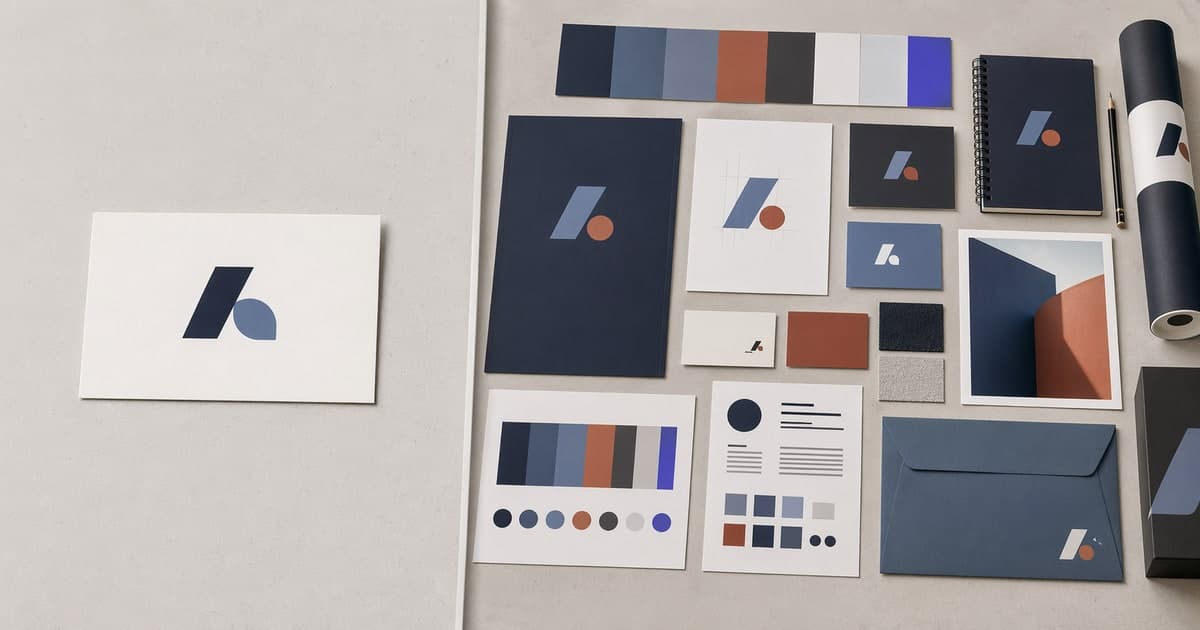
Most brands do not struggle because of budget. They struggle because they are built on avoidable structural mistakes that spread into every campaign, asset, and channel.
The good news is that these mistakes are predictable. If you spot them early, you can avoid them.
1. Confusing a logo with a brand
Having a logo is not the same as having a brand. If you have not defined tone, colors, typography, value proposition, and usage rules, you have a symbol, not a system.
2. Copying competitors
Studying references is useful. Copying their appearance is not. When everyone in your category uses the same visual codes, your business becomes interchangeable.
3. Choosing colors only because you like them
Your palette should not depend only on founder taste. It should respond to positioning, audience, differentiation, and readability.
4. Using too many typefaces
Three, four, or five unrelated fonts usually signal disorder. Most brands work better with a simple, intentional combination.
5. Documenting nothing
Without documentation, every future asset becomes improvisation. That slows down execution, drains the team, and creates inconsistent outcomes.
Create your professional brandbook in 15 minutes
Define your brand so your originality stays consistent when using AI
6. Ignoring brand voice
Many teams care only about visuals. Then email sounds formal, the website sounds technical, and social media sounds casual with no logic behind it. The brand loses cohesion.
7. Designing for only one channel
A brand must work on websites, presentations, social posts, proposals, PDFs, and small interface components. If it only looks good in a large mockup, it is incomplete.
8. Ignoring accessibility
Weak contrast, ultra-light typography, and hard-to-read blocks damage experience and credibility. Readability is not decoration. It is part of the identity.
9. Trying to look premium before being clear
Many brands try to look sophisticated before they become understandable. If people do not understand what you do, elegant visuals do not solve the friction.
10. Waiting too long to organize the brand
The longer you operate without a system, the more expensive the correction becomes. Every new misaligned asset increases brand debt.
How to avoid these mistakes
Work from a small but complete base:
- Clear positioning
- Simple value proposition
- Coherent colors and typography
- Defined brand voice
- Usable documentation
You do not need a perfect brand to start. You need one that is clear enough to repeat consistently.
Signs you need to fix your brand now
- Your website and social channels feel like different companies
- Every designer proposes a different style
- Nobody on the team knows what tone to use
- Your sales materials feel inconsistent
- Colors, messages, and criteria keep changing
Frequently asked questions
What is the most expensive mistake when creating a brand?
Treating branding as something superficial. When positioning, visual rules, and usage criteria are undefined, every future decision becomes slower and more expensive.
Is it okay to launch fast with an incomplete brand?
Yes, but not chaotically. You can launch with a simple brand as long as the fundamentals are clear and documented. Simplicity is not the problem; inconsistency is.
Create your professional brandbook in 15 minutes